Feb 052013
 

MH-cover-2013-smallPainter Anna Oneglia created the artwork for the cover of my novel of lost and found creativity, Maud’s House. I remember the first time my young daughter saw it she said, “It looks like Maud’s outside looking outside.” The story is about an artist who at one time was so full of creativity that she drew on the walls of her home. So Anna brought the Vermont autumn inside to Maud’s walls. But as the book opens, Maud has lost her muse, and the house that “was once covered in tattoos” has been painted white. Anna painted a lost Maud staring out the window, searching for inspiration.

Anyone can hit the wall, creatively speaking. There is writer’s block and artist’s block, times when the ideas refuse to flow, when the mind freezes because it is so jacked up on confusion or doubt or fear. There are organizations to help such as A.R.T.S. Anonymous, which helps artists recover their creativity through the Twelve Steps. “In A.R.T.S., bottom line sobriety begins with a humble daily action to pick up one’s creativity, ‘one day at a time’. Members are asked to do no less than five minutes of art every day. If one picks up even for five minutes, there will be days when five minutes turns into hours,” according to A.R.T.S. Anonymous.

Of course, we would never suffer the angst of being blocked if we never dreamed in the first place. It all starts with a dream. To finish that painting. To write that book. To live a life of dignity and peace. The It Gets Better Project was created to show gay and lesbian adolescents who are being bullied in their schools and communities that happiness and positivity is in their reach—if they can just get through their teen years.

What does this have to do with creativity? The point is we don’t give up, whether we are crying over an empty page or over the fact that everyone at school seems to hate us. If we can get through one more day, if we can put in just five minutes, we will grow stronger.

Anna Oneglia’s strong art was perfect for Maud’s House. She brings color and energy to everything she does, much in the way as I dreamed a young Maud would do. The California painter works in oils and mixed media and is also a printmaker producing block prints and lithographs. “The figure is central to my work, a grappling with how humans shape and are shaped by the world,” says Anna.

“In looking for art to make a difference,” Anna’s paintings have been published as posters for many causes, including Business Aid for AIDS, Bike to Work Week, The National Nurse Midwives Association, Celebration of the Muse, and the San Jose Women’s Commission.

I thank Anna for her wonderful vision, for showing that dreams are never truly lost; they are just waiting to be found again.

_________________________

Do you have an experience of being blocked? How did you overcome it? Please leave a comment. Also to read how Maud got her art back, I invite you to read Maud’s House.

Nov 112012
 

Where do your good ideas come from? Are you a genius or do you have a genius? There is a difference as Elizabeth Gilbert, author of Eat, Pray, Love, points out in a recent video about the creative process. She notes that early cultures believed they had a genius, “a divine spirit that came from a distant and unknowable source” that waited in the corner and gifted people with moments of brilliance: showed them a new way of doing something, popped a poem in their head, bestowed a new song to their ears.

Gilbert describes how poet Ruth Stone feels a poem rushing toward her over the landscape and how she races to the house to get a pen and paper to write down the poem before it passes her by. Stone doesn’t believe that she is a genius. She believes that she collects her poems from a genius.

Have you ever had those moments when an idea came into your head, a gift from the universe, from God, from your genius? Did you stop and take note or just carry on and say, “I’ll think about this later.” Don’t do it. Because if we are not geniuses (contrary to what our entitled society would like to have us believe), then we need help and we can’t afford to pass it by.

In some cultures, these moments of brilliance are called being “a glimpse of God,” Gilbert says. If you are in sports, it means you’re in the zone. If you are an artist, it could feel like you are transcendent, lit by divinity.

When I was writing Maud’s House, a novel about lost and found creativity, I was trying to express this idea of having a genius. There is a character in the book, a sheriff who builds birdhouses that resemble famous houses. Sheriff Odie Dorfmann also loves to play baseball. He describes a moment of genius on the baseball field to his friend George:

Odie told George what it would feel like to hit that ball. “I will know it’s the one the moment I connect. Its greatness will reverberate down my arm. I’ll feel it in my muscles; it’s impossible not to feel something that smooth. I’ll stand for a moment and watch it, contemplate the ball I sent to the stars, then I’ll skip once, twice, and head for first. I’ll take it easy, a token run for the crowds, but still the bases will disappear under my feet like the steps of an escalator. And when the reporters grab me and ask how it felt, I’ll just say, ‘It was heaven, boys, heaven.”’

Odie divulged to few people the rest of the dream. There was a feeling, he said, that always came over him at the end, just as the ball was almost out of sight, a feeling that it didn’t matter who had hit that ball, that it was headed for the universe at that particular moment in time and he just happened to be the guy who gave it a lift.

“Sometimes when I build birdhouses,” Odie told George that night in a whispery voice, “I get the same feeling, that I’m an instrument, a channel. It’s not a helpless feeling, not an out-of-control feeling because I seem to be not only the tool but the person using the tool.” Silence. “Weird, huh?”

If we show up and are open to the possibilities, who knows where genius will come from? Maybe you’ll get smacked by a genius while reading a blog, driving your car, or rambling through the jungles of Pinterest. My daughter is always looking for brilliant ways to organize her life. Recently, she asked me to help her create wardrobe organizers out of CD labels, one of her many Pinterest projects. CD-looking things bringing order to your fashion life. To the harried mother trying to get five kids dressed for school or the career woman who hates making decisions in the morning, this is a moment of genius.

Whether you believe you are a genius or, like me, prefer to have a genius, I have one wish for you today: May you be a glimpse of God.

_____________________

If you would like to read more about Odie Dorfmann, the baseball-playing, birdhouse-building lawman, as well as a whole town of people waiting for their geniuses, I invite you to check out Maud’s House.

I also invite you to watch the Elizabeth Gilbert video:

Jun 282012
 

A creative idea a day keeps the doctor away. And it doesn’t even have to be a big idea. We don’t have to be the next Michelangelo or be a whiz at creating things with pipe cleaners. We just have to practice what psychology professor Ruth Richards calls “everyday creativity.”

Richards, one of the researchers at Harvard Medical School, says expressive writing has been shown to improve immune system functioning, for example, and older people who think more innovatively tend to cope better with aging and illness. In an article in Psychology Today, she maintains that engaging in creative behaviors makes us more dynamic, conscious, nondefensive, observant, collaborative, and brave.

Creativity “makes you more resilient, more vividly in the moment, and, at the same time, more connected to the world,” Richards says.

What is everyday creativity anyway? And what are some everyday things you can do to enhance your creativity and get some of those healthy benefits?

Everyday creativity, as defined by Richards, is simply an expression of originality and meaningfulness. It could be something as simple as wearing blue eye shadow when you always wear gray or taking a different route to work just for the heck of it. If these things suddenly put a smile on your face, give you a lift, and open your spirit a little wider to the world around you, you just tapped your everyday creativity. Here are some more ideas:

  • Try a new recipe. I am always amazed to hear Lynne Rossetto Kasper of The Splendid Table on public radio take three disparate ingredients and come up with a whole new dish—and it’s not because boiling water is a challenge for me.
  • Discover the joy of writing morning pages. Julia Cameron, author of The Artist’s Way, encourages writers and nonwriters alike to start the day filling three pages of a notebook with their worries, joys, dreams, and thoughts. The idea is that once you take out the garbage, there is a ton of room for creativity. Who knows what you’ll think of?
  • Take a field trip. Go some place you’ve never been or do something you’ve never done. I personally find museums inspiring and calming, but I love to explore the unknown. I was at a Minnesota Twins baseball game recently and Rubbertoes (my husband) offered to arrange for me to run the bases. I’ve never stood on a major league baseball field before. If it hadn’t been 95 degrees and I hadn’t been frustrated with the team’s poor showing, I would have done it.
  • Turn your day upside down. That’s when you eat breakfast for dinner. I still get this feeling I’m pulling something over on someone when I have pancakes for supper. And if the pancakes are chocolate chip, I’m practically beaming. But this tip doesn’t have to be about food. Try looking at something one way and then flipping it around and looking at it another way. When Ralph Waldo Emerson visited Henry David Thoreau, who was in jail for refusing to pay a poll tax that supported slavery, Emerson said, “Henry, how did you come to be here?” Thoreau replied, “Ralph, how did you come to be out there?” Challenge your perceptions and energize your creativity.
Lost and found creativity is the topic of my novel Maud’s House. It has a postmistress who writes poetry, a minister who plays the sax, a dairy farmer who tap dances, and a sheriff who builds birdhouses modeled after historic residences. So what happens when the whole town loses its creativity? To celebrate creativity, I am giving away eBooks of Maud’s House from June 28-30. Go to Amazon and get one. Leave a review or comment here.
Feb 052012
 

This is a story of a woman who drew on the walls and the stove and the breadbox. Her name was Maud. And I fell in love with her spirit.

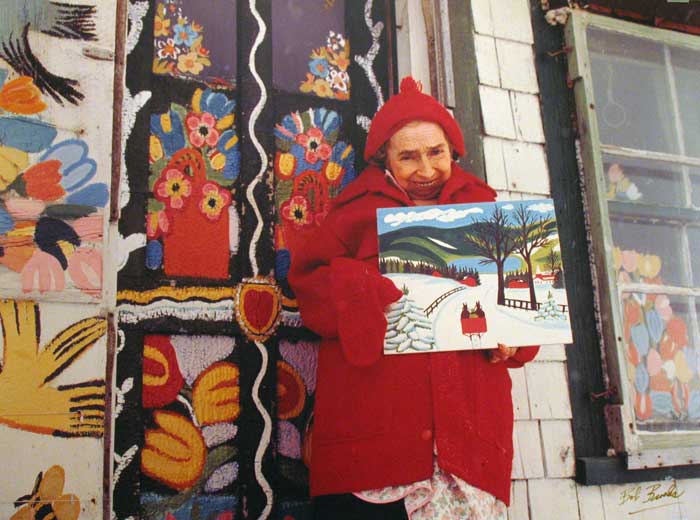
Folk artist Maud Lewis of Nova Scotia was a wee woman with such a great artistic spirit that her entire house has been preserved in the Art Gallery of Nova Scotia. The diminuitive dwelling doesn’t take up much space; it was only a 10 x 12 foot fisherman’s shack to begin with. Yet it was bursting with life when Maud lived there.

“Once this house was covered in tattoos.” That was the first line I wrote for my novel Maud’s House, after reading about Maud Lewis and seeing her artwork. Although my novel has nothing to do with Maud Lewis or her life, I hope it is imbued with her unquenchable desire to create. I couldn’t help but name my character Maud because she came to be as driven as the real Maud.

Pictures of Maud Lewis nearly always show her smiling and hiding her hands, which had begun to curl and become misshapen when she was 15. Her art is always joyful: brightly colored flowers, oxen with large curling eyelashes, glorious butterflies and birds. These were the things Maud saw from her window every day.

When I get stuck and consider complaining about how lousy the writing is going, I think of Maud and kick myself. She was a sickly orphan passed around from one poor relative to another until one day, in her thirties, she walked down the road from Digby to the isolated cabin of shy fish peddler Everett Lewis. Everett was impressed that his dog didn’t bark at their uninvited visitor. Apparently, Maud had passed some kind of test. Within weeks, they were married and living in their closet of a home.

Everett encouraged Maud’s love of painting and scrounged paints for his wife. Soon she was riding along on his fish route in the Model T selling hand-painted postcards—five for a quarter.  In the 1940s, Maud put out a roadside sign, “Paintings for sale,” and began selling small paintings to tourists for $2.50. By the time she died in 1970, at the age of 67, her paintings were being shipped to collectors all over the world.  

These are the things you should remember about Maud Lewis:

  • She never took a drawing lesson, read a textbook, or saw a work of art.
  • She contracted polio as a child and later was afflicted by arthritis. She lived in constant pain. By the end of her life, Everett had to lift her out of the bed in the morning, dress her, and set her by her easel and paints. And still she painted: everything in her house (even the windowpane), driftwood, cookie sheets.
  • In her final years, in the hospital with a broken hip and no longer able to control a paintbrush, she made Christmas cards for the nurses with felt pens.

When she was creating her art, Maud Lewis escaped pain, poverty, and the Nova Scotia cold.

She proved that the creative spirit makes everything seem bigger—life, love, even a painted doll house with no insulation or running water.

____________________

Visit the Painted House of Maud Lewis


Jan 232012
 

This book tour I am going in my pajamas.

MH-cover-2013-smallI am participating in the Get Loaded Blog Tour de Force sponsored by the Indie Book Collective this week, and I hope to get more mileage while putting on fewer miles. This is the new paradigm in publishing.

You see, in my last book tour (back in the ’90s when few people were talking about virtual anything much less a virtual book tour), I traveled for ten days from Los Angeles to Vermont to promote my book, Maud’s House. I talked to packed houses and empty ones; one horrendous thunderstorm washed away all my potential readers in Chicago.

Maud’s House is the story of a Vermont artist who loses and regains her creativity. As a child prodigy, Maud drew on the walls of her house, every square inch. As an adult, she is has lost her muse, drinks too much Rolling Rock, and seems to only be able to draw postcards featuring cows.

The neat thing about any book tour, virtual or physical, is meeting readers and learning about their lives. On the Maud’s House tour, I met readers who cracked me up and who touched me with their stories.

One woman admitted that she had begun writing again after reading my book: “I was raised in a strict home where we weren’t allowed to dance or paint or write. I’m in my fifties and starting my first journal.”

Another woman said she had a brother who, like Maud, drew on the walls. He was always getting in trouble with their mother. In the end, he became a successful artist. One day, the mother discovered one of her son’s early drawings secreted way on a wall inside a closet. She seriously considered cutting that part of the wall out and having it framed.

I hope to meet more great readers on this tour. Come back to this blog on Thursday, January 26, my featured day of the tour, and let’s talk. I am promoting my new novel, Book of Mercy, this time. It’s a funny novel about a serious issue (censorship), so we’ll have lots to discuss.

See you Thursday. I’ll be in my PJs, so don’t dress up on my account.

________________________________

What’s on your mind? I’m listening. Maud’s House is about pursuing your creativity no matter where it takes you: to the painting studio, the kitchen, the garden, the antique car in your garage. What do you take to the level of an art? Leave a comment below.

Sep 092009
 

As anyone knows who has read my novel on art and creativity, Maud’s House, I am a sucker for art in unusual places or unusual art in expected places. The Twin Cities is full of such wonderful surprises. Here’s the story of just one. I wrote this article in 2009, but I recently revisited the sculpture garden and was delighted to find a few wind chimes still left, wooing us with their musical whisperings.

The lovely thing about taking a blind man to a sculpture garden is that he can touch all the artwork—something frowned upon by most museums and galleries. I should know; a security guard almost tackled me once when he thought I was trying to shake the hand of a sculpture in the Rhodin Museum in Philadelphia. That was ridiculous, of course; that sculpture had hands the size of hubcaps.

The troublesome thing about taking a blind man to a sculpture garden is that the art is humongous—and often modern. So on this Saturday afternoon, I found myself in the Walker Sculpture Garden trying to make sense of modern art to someone who could not see it and had a heck of a time wrapping his arms around it

Then we came upon the grove of trees across from Minneapolis’ most famous outdoor installation, a cherry balanced in the bowl of a reclining spoon. And suddenly art made sense. A wonderfully crazy artist named Pierre Huyghe had the idea to hang 50 wind chimes in the trees and let the wind play music. The chimes project was inspired by John Cage’s 1948 score “Dream.”

The chimes included wind pipes that seemed to hum in different tones as they jingled gently in the wind. I felt surrounded by praying monks in a temple in some exotic land. Surely, this was the true sound of OM. Huyghe made a pipe for each note of Cage’s composition. So as you walk under the trees you hear the hum of the pipes sprinkled with the laughter of the chimes, and each moment is different according to the wind’s whim. The randomness is so Cage and so enchanting.

As I watched one person after another enter the grove of wind music, I realized we were all reacting in a similar way. We lift our chins into the breeze, close our eyes, and smile. The air bathes us in music, a sound so natural that it seems part of the trees and sky and us. When the wind shifts, we feel spray from the “Spoonbridge and Cherry” sculpture fountain in the center of the garden. We are happy.

My blind friend Neal, who will record about anything anywhere, immediately bemoaned about leaving his recording equipment behind. The bells of the Basillica of St. Mary nearby sounded and, for the first time that I can remember, I grew impatient with that usually pleasant song. I wanted to hear the wind music—not church bells, not speeding cars on Hennepin, not people talking. I never wanted to leave that vortex of soothing sound.

I love the sounds Minnesota makes with wind and trees, with pines that roar and aspens that clack. It makes me think I am lucky to live here. And now there is another reason, 50 of them, in fact. When the wind chimes come down, as they eventually must, this grove won’t be the same, ever again, for many people. We will walk through here and remember a Saturday afternoon when nature serenaded us and a blind man heard art.